Telling stories is one of the most important tools we have and the ones we hear have a lot of influence over us. During the last three years I have sought to find new and innovative ways to tell stories. There are so many ways to communicate a story and as a result of this I've made it my intention to sample and experiment with a range of methods. This creates work that is immersive and that people can connect with. In the future, a long term aim is to found a dedicated company for telling new stories, such as an animation studio or a game development company.
In July 2017 I will be graduating from the BA (Hons) Animation degree from Leeds College of Art with a first class honours. My background is in animation with a specific involvement in the design process behind it. My focus as an artist and illustrator is on creating atmospheric and unique worlds that immerse the audience. Aside from this, I enjoy writing and creating worlds in this way which often acts as a way to inform the content I create. During the last three years I have sought to find new and innovative ways to tell stories. There are so many ways to communicate a story and as a result of this I've made it my intention to sample and experiment with a range of methods, creating work that is immersive and that people can connect with.
My creative skills lie in storytelling, world building and in a more practical sense, the early stage of projects with my work mostly revolving around the creation of concept artwork, storyboarding and the design of characters and environments. I enjoy the design process and taking ideas from concept to tangible works in the form of visual designs and illustrations.
Thursday, 18 May 2017

Wednesday, 17 May 2017
OUAN602 - Developing Showreel
With my 2017 showreel I attempted to demonstrate a somewhat diverse body of work that taps into all of the best things I have produced over the past couple of years. I chose to include the vast majority of the work from the past year since that is the most recent but also picked small segments from previous years to demonstrate a more diverse range of work and skills.
From here I plan on either adding 2D images that I've created throughout my portfolio and using some movement to depict them, but perhaps a better idea would be to create a completely separate showreel demonstrating my concept and pre-production work including storyboards, backgrounds, character design and other images that influence the beginning stage of project production.
From here I plan on either adding 2D images that I've created throughout my portfolio and using some movement to depict them, but perhaps a better idea would be to create a completely separate showreel demonstrating my concept and pre-production work including storyboards, backgrounds, character design and other images that influence the beginning stage of project production.
OUAN602 - Novel Opening Chapter & Synopsis Competition
As part of my ongoing investigation into the ways in which writing can be practiced and opportunities made to provide professional content for publication, I've been looking into competitions and entering them where I can.
An opportunity arose when I came across a competition for an 'opening chapter and synopsis'. For this I decided to include the story I produced for extended practice. I entered this because I had a long first chapter, but also the synopsis of the full length story was planned out and completed in the sense of an outline for the overall plot. I don't think this is the type of competition that could be entered on a regular basis because the requirements of the content to submit is quite substantial, but I decided to go for it in this case because I was already had one I was happy with.
 <
<

An opportunity arose when I came across a competition for an 'opening chapter and synopsis'. For this I decided to include the story I produced for extended practice. I entered this because I had a long first chapter, but also the synopsis of the full length story was planned out and completed in the sense of an outline for the overall plot. I don't think this is the type of competition that could be entered on a regular basis because the requirements of the content to submit is quite substantial, but I decided to go for it in this case because I was already had one I was happy with.
<
OUAN602 - The Lifting Tower Brief
The lifting tower brief was introduced to us in the lecture theatre as a year group early on in the year. After hearing the brief I was excited to at the opportunity to undertake another collaborative brief, and intended to work at least at the start of the brief with other animation students. I approached Ollie and Oscar and we formed a group with the addition of Hattie from graphic design. During the briefing Fred [who delivered the brief] described the process we would undergo. This involved splitting into groups and coming up with visual ideas and then the organisation who commissioned the brief would pick their favourite ideas to narrow down the selection. Following this the people working on the brief would concentrate on the best ideas in order to bring the brief to a close before the Christmas events began in Leeds. We had several meetings straight away where we discussed ideas at length before working on individual ideas separately in order to gauge how they would work given the limitations and description of the final outcome in the brief.
Below is part of the initial work I produced to visualise my idea. It included following an owl [representative of the Leeds Owl] around the city centre and then as it flies out to more rural areas around Leeds. This was quite a complex idea in hindsight and I can see why it was unsuccessful. Furthermore, I should have paid more consideration to the nature of the brief and thought about the way the idea would be projected in the final outcome.
Following this, we had the chance to speak to consult with a representative from Lumen who gave us more details about the way the projector worked and what kinds of work will be successful and unsuccessful. Based on this we altered our ideas further and eventually assembled a range of successful short animations to be projected onto the tower.


Below is part of the initial work I produced to visualise my idea. It included following an owl [representative of the Leeds Owl] around the city centre and then as it flies out to more rural areas around Leeds. This was quite a complex idea in hindsight and I can see why it was unsuccessful. Furthermore, I should have paid more consideration to the nature of the brief and thought about the way the idea would be projected in the final outcome.
Following this, we had the chance to speak to consult with a representative from Lumen who gave us more details about the way the projector worked and what kinds of work will be successful and unsuccessful. Based on this we altered our ideas further and eventually assembled a range of successful short animations to be projected onto the tower.
OUAN602 - Thoughtbubble 2016
Despite being in Leeds for three years now, this was my first year attending Thoughtbubble. The Thought Bubble Festival is the UK’s largest event celebrating sequential art. It is a huge coming together of different artists that produce work from superhero comics to independent and small-press works. The festival is essentially a way for artists and writers, creators of art in general to come together and buy/sell work with the addition of having a domain to communicate and meet people in the process.
The festival was a little different from what I expected and was a lot larger than I had imagined, so much so that it was almost overwhelming at times in terms of the amount of content and entertainment confined to a single area. Even having spent several hours there I left feeling like I hadn't managed to see everything I wanted to, or at the very least the things worth seeing for me personally. It was an especially positive experience seeing the broad range of work and levels of professionalism that were present. I had the chance to speak to semi-profession artists, students and full time artists and gather experience and insight from each one of the individuals I approached. I tried to use this as an opportunity to gather information regarding the processes of different artists as well as some industry insight, at the time partly in preparation for the COP3 comic book I wanted to produce. Most of the responses said that it took a day to several days per page from beginning to end, and this sounded like a lot of time but of course a lot of work goes into a page worth of illustrations - and combined with the writing and colouring/inking etc. it seemed like an appropriate time frame on reflection. So this was something to keep in mind moving forward with my own practice.
I made a few purchases whilst I was there and was very happy with the selection I made. I purchased three books in total and attempted to buy stories and comic books that I wouldn't normally consider, I did this in an attempt to broaden my reading and insight into the different work out there. Finally, after leaving the festival it had me considering the opportunities in the future to attend myself and if I produced the work necessary to attend as an artist, the benefits it would have in terms of getting feedback, talking to people and getting my work seen.
The festival was a little different from what I expected and was a lot larger than I had imagined, so much so that it was almost overwhelming at times in terms of the amount of content and entertainment confined to a single area. Even having spent several hours there I left feeling like I hadn't managed to see everything I wanted to, or at the very least the things worth seeing for me personally. It was an especially positive experience seeing the broad range of work and levels of professionalism that were present. I had the chance to speak to semi-profession artists, students and full time artists and gather experience and insight from each one of the individuals I approached. I tried to use this as an opportunity to gather information regarding the processes of different artists as well as some industry insight, at the time partly in preparation for the COP3 comic book I wanted to produce. Most of the responses said that it took a day to several days per page from beginning to end, and this sounded like a lot of time but of course a lot of work goes into a page worth of illustrations - and combined with the writing and colouring/inking etc. it seemed like an appropriate time frame on reflection. So this was something to keep in mind moving forward with my own practice.
I made a few purchases whilst I was there and was very happy with the selection I made. I purchased three books in total and attempted to buy stories and comic books that I wouldn't normally consider, I did this in an attempt to broaden my reading and insight into the different work out there. Finally, after leaving the festival it had me considering the opportunities in the future to attend myself and if I produced the work necessary to attend as an artist, the benefits it would have in terms of getting feedback, talking to people and getting my work seen.
OUAN602 - Business Card Developement
I produced these 'templates' for business cards much earlier in the year. The reason I wanted to have the very least a basic business card made and ready to distribute as needed was in time for Manchester Animation Festival. The design I chose to adopt was relatively simplistic compared to some of the alternatives I've seen and consists of an image of my work on one side with my contact details, profession and website on the reverse. This style was based on looking at the range of business cards I picked up from different artists at the Thoughbubble convention in September of last year.


OUAN602 - Another Attempt at Self Branding [Twitter, Instagram, Linkedin]
In an attempt to self brand and build a presence from scratch, I came up with the username 'tiredise' a while ago, which has stuck on my social media accounts and eventually became the name of my website. The idea of self branding to me relies on consistency as well as a strong, and equally unique approach to branding that will result in a memorable way to deliver your work to an audience. In order to accomplish this, I first made sure that the social media platforms I do use have the same handle so that in the event that someone was searching for my name, or work, everything would appear. This makes it less of a task for people interested in you or your work to locate you on the various social media platforms. In my case, I primarily focus on Instagram and Twitter. Instagram is good source of inspiration and a good way to support, and be supported by commenting and bumping up posts with interaction. One the occasions that I have tagged my work with identifiers there is a notable increase in terms of the interaction with a specific post, but usually I try to keep this to a maximum of three separate tags or I think it begins to look unpleasant in the image caption. Generally I use Instagram to show snippets of work I like, and usually I will try to post images that work well with the other things I have posted in order to establish a 'theme' on my profile. In contrast to this, I feel like my Twitter presence is lacking and I could definitely make an effort to follow more people, artists and practitioners as well as studios and larger organisations. Following this, if I interact it will mean that there is more of a chance of creating connections on that platform and thus, generating a larger network.
One thing that I am skeptical about creating currently is a logo. It seems like few artists use one on their social media and instead use either images of themselves or their work, which makes sense to me. I think if I began a small company or a brand that dealt in a specific thing then I would certainly create a logo to represent the company or brand. I also think that a logo is a difficult thing for me to come up with currently, and as a result I don't want a the lacklustre creation to have a detrimental effect on the visual aspects of my online presence.


One thing that I am skeptical about creating currently is a logo. It seems like few artists use one on their social media and instead use either images of themselves or their work, which makes sense to me. I think if I began a small company or a brand that dealt in a specific thing then I would certainly create a logo to represent the company or brand. I also think that a logo is a difficult thing for me to come up with currently, and as a result I don't want a the lacklustre creation to have a detrimental effect on the visual aspects of my online presence.

OUAN602 - Ambitions
Apart from the normal career path I'm looking to take along the freelance lines, I want to one day whether in the near future or in several years to found a start-up studio that will involve creating either animation, film or game development work. I haven't decided whether I want to work in the development of games or entertainment but I am open to both at the moment. I intend to find individuals to do this with based on connections I form within the industry. The reason I want to do this too much is I far enjoy working on animations and the creation of new content in a team environment rather than by myself. Although personal projects require some kind of solitary work environment, the coming together of different creative minds and the work that can be produced through hard work and collaboration far surpasses that of the individual and striving to create new worlds and stories will require this type of input. Overall, being able to produce content with other artists and practitioners from different backgrounds not only sounds like an exciting and enjoyable prospect, but also a challenging one, and the challenge of this endeavor is something I want to try to over come.
This is also influenced by the practitioners and studios that spoke during MAF. To hear about the creative outlets both in terms of client work but in the personal studio projects that they become involved with was definitely inspiring and the kind of attitude that I'm glad studios take towards work. Putting a strong creative spin on different client projects that in turn fuel other creative outlets sounds like a perfect way to sustain a studio of artists striving to create original content.
The self-sustaining advantage of a company that produces media in this way is very appealing and something I would like to use my experience and ideas to one day pull together and work with others to create new and original works with.
This is also influenced by the practitioners and studios that spoke during MAF. To hear about the creative outlets both in terms of client work but in the personal studio projects that they become involved with was definitely inspiring and the kind of attitude that I'm glad studios take towards work. Putting a strong creative spin on different client projects that in turn fuel other creative outlets sounds like a perfect way to sustain a studio of artists striving to create original content.
The self-sustaining advantage of a company that produces media in this way is very appealing and something I would like to use my experience and ideas to one day pull together and work with others to create new and original works with.
OUAN602 - Creating a Website & Online Portfolio
I considered several platforms that would be suitable to host the website I wanted to create and an online portfolio, out of the different services I came across SquareSpace was relatively well priced and also offered the best service in my opinion. With a student discount they offer the domain and website hosting with 50% deducted from the regular price. SquareSpace also appealed the most because for a set price you were given full creative control over the website in contrast to other platforms which would require paying more for modifying the html or editing certain templates that were installed on the web pages. This was a deal breaker for me because I wanted to have full control over the aesthetic and layout of the website without being in a position where I couldn't do what I wanted with it. The domain was an additional benefit of purchasing the package I did as normally this would occur an additional cost. I took the handle I used for Twitter and Instagram to keep all the different online outlets I was present on consistent.
Each webpage that you create has a number of options straight away that allow you to set the basis of a webpage. For example a page that is required to host video, a certain layout such as a contact page or a portfolio page for images all have their own default options that can be applied and then changed as required using the intuitive editing system in place. Especially useful was the ability to embed a blog into one of the webpages which means I can combine my blog with my website when it is up and running. Finally, the big advantage of this service has been a time saving one, and it means in just a few hours you can have a basic website up and running. From here I play to refine my website further when I have more work to add and more time to really customise the website to be the way I want it. Although currently it is doing its job I would like it to really stand out as an online portfolio and intend to work on it further to achieve this.


Each webpage that you create has a number of options straight away that allow you to set the basis of a webpage. For example a page that is required to host video, a certain layout such as a contact page or a portfolio page for images all have their own default options that can be applied and then changed as required using the intuitive editing system in place. Especially useful was the ability to embed a blog into one of the webpages which means I can combine my blog with my website when it is up and running. Finally, the big advantage of this service has been a time saving one, and it means in just a few hours you can have a basic website up and running. From here I play to refine my website further when I have more work to add and more time to really customise the website to be the way I want it. Although currently it is doing its job I would like it to really stand out as an online portfolio and intend to work on it further to achieve this.
OUAN602 - Festival Strategy: How to Promote Work
One way to promote work I have been looking into is the festival strategy and getting finished work into a festival to be shown. This is not a viable route for my graduation film because of the nature of the story and the way it wouldn't make sense out of the context of a franchise piece. However this is something I want to work towards after graduation, and maybe work with others to create something festival worthy rather than alone. One thing that is clear regarding successful festival submissions and the work displayed there, [which was especially evident with MAF] was that even the most simple of films had multiple people working on them with dedicated roles and individuals working on specific aspects to the films instead of an individual doing everything.
Creating a film with multiple individuals all working towards a finished piece is something I definitely want to start doing more of, and it ties back heavily to the ambition I have of founding a studio or collective dedicated to producing short films or games, or other entertainment projects.
Creating a film with multiple individuals all working towards a finished piece is something I definitely want to start doing more of, and it ties back heavily to the ambition I have of founding a studio or collective dedicated to producing short films or games, or other entertainment projects.
OUAN602 - Visiting Lecturerer: Bianca Ansems
On the day of the Extended Practice hand in and a week before the final PPP3 deadline we had a visiting lecturer, Bianca Ansems. Bianca is a storyboard artist and animation director, living in London, UK.
'She is a storyboard revisionist at Cartoon Network, and before that storyboarded a.o. the cutscenes for the game ‘Volume’ (Bithell Games), several episodes of ‘Toot the Tiny Tugboat’ (Lupus Films), an advert for Gucci, and several shorts for the British Council (Slurpy Studios). She also has worked as an animation director for clients such as the BBC, House of Fraser and the City of London. She studied at the National Film & Television School and AKV St.Joost (NL), with internships at Aardman Studios (UK) and Studio Lutterbeck (D). Her MA graduation film ‘Playing Ghost’ picked up several awards and screened at over 40 festivals including Hirshima AFF, Anima Mundi and Stuttgart AFF.'
As a visiting lecturer she was one of the favourite visiting speakers that I have seen, both for her honest first hand experiences of the industry but also the positive attitude she had towards freelancing and being a generalist within the industry. These are both things I think I do or am, and want to pursue. It was very motivating and in some forms reassuring to have her talk so openly and enthusiastically about the freelance side of the animation industry and being a storyboard artist that doesn't or has gone through stages of working completely freelance. She mentioned that through her freelance career she has only endured two weeks total without knowing where the next job was coming from. This sense of stability without being tied to a specific role was quite reassuring, and she spoke about her love for freelance and being able to manage her own work and time which is something I really want to be able to do myself. Furthermore, her freelance work is very general and after looking at her online portfolio it is quite evident that the breadth of her work is very general similar to my own. Her website contains animation, storyboarding, illustration and a few other roles she has adopted through her freelance career. She spoke at some length about clients and the way the communication usually goes. Most of the jobs Bianca said she gets come through e-mail, which is something to keep in mind. In addition, she said that it is best to be as professional and as polite as possible when working in this way, because if you don't word will get around regarding your attitude or the way you handle yourself professionally, in turn having a negative impact on your work and opportunities. Finally, she spoke about networking in terms I haven't really heard before in that it is more about forming friendships than handing out business cards.
'She is a storyboard revisionist at Cartoon Network, and before that storyboarded a.o. the cutscenes for the game ‘Volume’ (Bithell Games), several episodes of ‘Toot the Tiny Tugboat’ (Lupus Films), an advert for Gucci, and several shorts for the British Council (Slurpy Studios). She also has worked as an animation director for clients such as the BBC, House of Fraser and the City of London. She studied at the National Film & Television School and AKV St.Joost (NL), with internships at Aardman Studios (UK) and Studio Lutterbeck (D). Her MA graduation film ‘Playing Ghost’ picked up several awards and screened at over 40 festivals including Hirshima AFF, Anima Mundi and Stuttgart AFF.'
As a visiting lecturer she was one of the favourite visiting speakers that I have seen, both for her honest first hand experiences of the industry but also the positive attitude she had towards freelancing and being a generalist within the industry. These are both things I think I do or am, and want to pursue. It was very motivating and in some forms reassuring to have her talk so openly and enthusiastically about the freelance side of the animation industry and being a storyboard artist that doesn't or has gone through stages of working completely freelance. She mentioned that through her freelance career she has only endured two weeks total without knowing where the next job was coming from. This sense of stability without being tied to a specific role was quite reassuring, and she spoke about her love for freelance and being able to manage her own work and time which is something I really want to be able to do myself. Furthermore, her freelance work is very general and after looking at her online portfolio it is quite evident that the breadth of her work is very general similar to my own. Her website contains animation, storyboarding, illustration and a few other roles she has adopted through her freelance career. She spoke at some length about clients and the way the communication usually goes. Most of the jobs Bianca said she gets come through e-mail, which is something to keep in mind. In addition, she said that it is best to be as professional and as polite as possible when working in this way, because if you don't word will get around regarding your attitude or the way you handle yourself professionally, in turn having a negative impact on your work and opportunities. Finally, she spoke about networking in terms I haven't really heard before in that it is more about forming friendships than handing out business cards.
OUAN602 - Visiting Lecturer : Reg Isaac
Reg Isaac is a London based 2D character animator who came as a visiting speaker. One of the most valuable things about having him as a speaker is unlike most of the other speakers he wasn't reflecting on a long career in the creative and animation industries but more he was speaking from only recently being in a position more or less identical to ours. At 24 he is a recent graduate and spoke about his first steps getting work and how he goes about making sure that there is always another job waiting, or to the best of his ability make this the case. It was valuable to hear him discuss the way he got a job out of University [through a tutor] and how this led to other work. At the end of the talk I took the opportunity to ask how a recent graduate would be able to move to London without having any money saved up prior to starting the few month long role he got in London. His response was that he had family there and was able to work something out using this. This was insightful but I was hoping he had some advice about the ways in which moving to London would be possible without going from one job to another and instead going from education, as a lot of the jobs I have seen are London based.
Another piece of advice he had was to draw as much as possible. He mentioned that during University he took a short holiday to Cornwall purely for the purpose of drawing as much as possible. This was a great idea that I hadn't considered before, and after seeing how has improved his drawing in such a short amount of time it convinced me that you really get out what you put in.
Overall, the Reg Isaac talk was very inspirational because he was talking from a position very close to ours and it was a very relatable talk in this sense. Furthermore, his attitude towards drawing and maintaining a good work ethic was motivating in itself and I will definitely try to ensure I do this to benefit from implementing a good attitude towards work and my practice.

Another piece of advice he had was to draw as much as possible. He mentioned that during University he took a short holiday to Cornwall purely for the purpose of drawing as much as possible. This was a great idea that I hadn't considered before, and after seeing how has improved his drawing in such a short amount of time it convinced me that you really get out what you put in.
Overall, the Reg Isaac talk was very inspirational because he was talking from a position very close to ours and it was a very relatable talk in this sense. Furthermore, his attitude towards drawing and maintaining a good work ethic was motivating in itself and I will definitely try to ensure I do this to benefit from implementing a good attitude towards work and my practice.
OUAN602 - Plans / Strategy After Graduation
After completing the past three years I finally think I understand what I enjoy, even if that is broad and I have to succumb to the idea of being a generalist. Bianca Ansems cemented this for me because it showed me that from her work as a storyboard artist / illustrator / animator director she can still be successful without fulfilling one role within the industry. Aside from my working developing a lot since the beginning of the course, I also think I have chanced as a person - or at least my attitude to my work has changed. I went into the course hoping to work as hard as I could and in a way prove to myself that I could achieve things without any other incentives than from myself.
I think my creative skills lie in storytelling, world building and in a more practical sense, illustration and specifically in the animation terms the pre-production stage. I enjoy the design and enjoy taking ideas and creating tangible works such as designs, illustrations that form the basis of media. My plans for the immediate future are to of course continue developing and improving the skills I mentioned, and in terms of establishing myself and a career, the freelance option seems like the best for me given my current circumstances. I think this will give me the best options in terms of learning and developing as a professional, but also building a portfolio simultaneously so that if a permanent or semi-permanent position does arise, I can use this professional experience combined with my portfolio to apply and maybe get it - not against getting a position in a studio. Difficult to say what will happen, so keeping different options open.
Aside from working freelance doing illustration / animation etc. I want to continue to write, whether this be through competitions - for myself or in an attempt to get something published. I have looked into being published in online publications and there are a lot of opportunities. For writing as well, there is the Leeds Writer’s Circle which is held every week and is a social event where writers have their manuscripts critiqued. There is also the writers guild, another support network for writers.
Aside from this, there is of course things I want to do that perhaps wasn’t available for me to do for either financial or time reasons for example, seeing new places and having new experiences that may also inform different aspects of my work. - life experience is often a contributor to the quality and imagination an artist can put into their work. Specifically about the options to freelance, it seems quite common knowledge at least to the people who have gone and done it, that one of the best ways to get freelance opportunities is to network in the sense that you form relationships but also do good work, so that people recommend you or rehire you. And of course, something else that Bianca Ansems said was in reference to way you speak to people and the way you handle and conduct yourself so these are things to consider when attempting this type of work.
I think my creative skills lie in storytelling, world building and in a more practical sense, illustration and specifically in the animation terms the pre-production stage. I enjoy the design and enjoy taking ideas and creating tangible works such as designs, illustrations that form the basis of media. My plans for the immediate future are to of course continue developing and improving the skills I mentioned, and in terms of establishing myself and a career, the freelance option seems like the best for me given my current circumstances. I think this will give me the best options in terms of learning and developing as a professional, but also building a portfolio simultaneously so that if a permanent or semi-permanent position does arise, I can use this professional experience combined with my portfolio to apply and maybe get it - not against getting a position in a studio. Difficult to say what will happen, so keeping different options open.
Aside from working freelance doing illustration / animation etc. I want to continue to write, whether this be through competitions - for myself or in an attempt to get something published. I have looked into being published in online publications and there are a lot of opportunities. For writing as well, there is the Leeds Writer’s Circle which is held every week and is a social event where writers have their manuscripts critiqued. There is also the writers guild, another support network for writers.
Aside from this, there is of course things I want to do that perhaps wasn’t available for me to do for either financial or time reasons for example, seeing new places and having new experiences that may also inform different aspects of my work. - life experience is often a contributor to the quality and imagination an artist can put into their work. Specifically about the options to freelance, it seems quite common knowledge at least to the people who have gone and done it, that one of the best ways to get freelance opportunities is to network in the sense that you form relationships but also do good work, so that people recommend you or rehire you. And of course, something else that Bianca Ansems said was in reference to way you speak to people and the way you handle and conduct yourself so these are things to consider when attempting this type of work.
OUAN602 - Creating a Writing Blog
As part of my ongoing and relatively new writing endeavor I play on creating a writing blog specifically designed to host all of the shorter work I write. I don't think that I will be publishing longer work on there, or anything I intend to send to a publication or works I try to get published won't be put on there, but anything else, recreational writing or just short story ideas and simple works will be on there. As a follow on from this I plan on producing short stories on a regular timely basis, which serves two purposes. Firstly, it will encourage me to have a stable timetable that if my freelancing plan does go ahead and I'm placed into that position, then it will give additional structure and stability to my daily and working life. Furthermore, it means that a regular stream of content will be being published and made available to anyone wanting to read as well as a steady record and portfolio of my own work for myself. I could have bi-monthly or even weekly uploads to the writing blog, with where possible adding an additional story or two if I am capable. This baseline goal will provide a reference point for me to work from in regards to the keeping and maintaining of writing stories.
The benefits of going ahead with this project is that of course it would allow me to progress and develop my writing on a regular basis, as well as being able to distribute it on a free platform. Providing myself with the previously mentioned benefits or an on going online portfolio but also provides free content to any one interested in the audience that comes across it. This is something I plan to start immediately after submitting the PPP module, I've been planning on doing it for a while but once this has been finished then I can start devoting my time and resources to all of the other projects I'm looking to undertake.
The benefits of going ahead with this project is that of course it would allow me to progress and develop my writing on a regular basis, as well as being able to distribute it on a free platform. Providing myself with the previously mentioned benefits or an on going online portfolio but also provides free content to any one interested in the audience that comes across it. This is something I plan to start immediately after submitting the PPP module, I've been planning on doing it for a while but once this has been finished then I can start devoting my time and resources to all of the other projects I'm looking to undertake.
Monday, 15 May 2017
OUAN602 - Biography / Statement
"Telling stories is one of the most important tools we have and the ones we hear have a lot of influence over us. During the last three years I have sought to find new and innovative ways to tell stories. There are so many ways to communicate a story and as a result of this I've made it my intention to sample and experiment with a range of methods. This creates work that is immersive and that people can connect with.
In the future, a long term aim is to found a dedicated company for telling new stories, such as an animation studio or a game development company."
In the future, a long term aim is to found a dedicated company for telling new stories, such as an animation studio or a game development company."
OUAN602 - Gathering Information from Industry Professionals
For the purpose of COP3, I spent some time sending out e-mails and trying to get in contact with individuals in the field I was looking at. I think I could have attempted to contact twenty people in total, and was happy to get replies from three of those. This aside from being an attempt to gather research for my dissertation I found it to also be a valuable lesson in how to contact people, not just to network but to also ask them for help and advice. It seems that in general if people reply it is because they are happy to help and want to be involved with the work you do, whereas people who aren't interested or have too many things to do will simply not reply rather than write you an e-mail tell you so.
A simple lesson overall but a valuable experience in terms of communicating with industry professionals and formatting an appropriate form of written communication including the appropriate etiquette and approach to the topics.
A simple lesson overall but a valuable experience in terms of communicating with industry professionals and formatting an appropriate form of written communication including the appropriate etiquette and approach to the topics.
OUAN602 - Umberto Eco, Italo Calvino, James Joyce & China Miéville
Following on from my attempts to write more I also want and intend to compliment this as much as possible by reading more. I started with four cherry picked authors to read in order to expand the range of books, which would also help and inform my work for the extended practice module.
China Mieville is a writer that I have been reading for a long time but haven't returned to in the past few years. In order to refresh my memory of his work and the type of stories he produces a long with language, themes and most importantly for me, world building. I read sections of Perdido Street Station which is one of my favourite books especially from Mieville. I also read different stories from one of his short story collection: Jake & Other Stories. This was particularly enjoyable and particularly useful because within this book there is both a range of genres and a range of forms that the different stories take; some letters, some scientific reports and some more familiar in their delivery.
Italo Calvino was brought to my attention by Annabeth when talking about different authors I should read. Several days after we spoke I purchased If On a Winter's Night a Traveller and Invisible Cities. So far I am enjoying reading If On a Winter's Night a Traveller and learning a lot as I do. The book has another unusual format because it follows a structure and what is most interesting to me looking at the book on a basic level is that 'you' i.e the reader becomes the main character because of the structure put in place by Calvino. - "The book begins with a chapter on the art and nature of reading, and is subsequently divided into twenty-two passages. The odd-numbered passages and the final passage are narrated in the second person. That is, they concern events purportedly happening to the novel's reader. (Some contain further discussions about whether the man narrated as "you" is the same as the "you" who is actually reading.) These chapters concern the reader's adventures in reading Italo Calvino's novel, If on a winter's night a traveler."
James Joyce is an author I am also interested in ready because he is again described as an avant-garde author and perhaps one of the most influential writers of the 20th century. Out of his work I intend to read the book Ulysses, a landmark work that takes the episodes of Homer's 'Odyssey' [with Ulysses being the latinised name for Odysseus] and parallels the stories in an array of contrasting literary styles. This is an example of the stream of consciousness style he pioneered. The book has also been described as a good depiction of the modern literature movement.
Finally, another Italian author, Umberto Eco - a writer and essayist who has written a large amount on biblical analysis, medieval studies and literary theory. All topics I'm interested in and think I would benefit in some ways from reading his work and analysis of different topics.
China Mieville is a writer that I have been reading for a long time but haven't returned to in the past few years. In order to refresh my memory of his work and the type of stories he produces a long with language, themes and most importantly for me, world building. I read sections of Perdido Street Station which is one of my favourite books especially from Mieville. I also read different stories from one of his short story collection: Jake & Other Stories. This was particularly enjoyable and particularly useful because within this book there is both a range of genres and a range of forms that the different stories take; some letters, some scientific reports and some more familiar in their delivery.
Italo Calvino was brought to my attention by Annabeth when talking about different authors I should read. Several days after we spoke I purchased If On a Winter's Night a Traveller and Invisible Cities. So far I am enjoying reading If On a Winter's Night a Traveller and learning a lot as I do. The book has another unusual format because it follows a structure and what is most interesting to me looking at the book on a basic level is that 'you' i.e the reader becomes the main character because of the structure put in place by Calvino. - "The book begins with a chapter on the art and nature of reading, and is subsequently divided into twenty-two passages. The odd-numbered passages and the final passage are narrated in the second person. That is, they concern events purportedly happening to the novel's reader. (Some contain further discussions about whether the man narrated as "you" is the same as the "you" who is actually reading.) These chapters concern the reader's adventures in reading Italo Calvino's novel, If on a winter's night a traveler."
James Joyce is an author I am also interested in ready because he is again described as an avant-garde author and perhaps one of the most influential writers of the 20th century. Out of his work I intend to read the book Ulysses, a landmark work that takes the episodes of Homer's 'Odyssey' [with Ulysses being the latinised name for Odysseus] and parallels the stories in an array of contrasting literary styles. This is an example of the stream of consciousness style he pioneered. The book has also been described as a good depiction of the modern literature movement.
Finally, another Italian author, Umberto Eco - a writer and essayist who has written a large amount on biblical analysis, medieval studies and literary theory. All topics I'm interested in and think I would benefit in some ways from reading his work and analysis of different topics.
Sunday, 14 May 2017
OUAN602 - Writing Opportunities
I've spoken briefly about writing competition and the writer's groups and guilds that are accessible to someone who wants to improve their writing and become involved in this aspect of the industry. Along side these however, there are some other opportunities I have been looking into and discovering that may also lead to reaching my goals in this area.
After I decided to pursue this more seriously and attempt to work on this practice in order to inform and produce better work, I began looking for resources to encourage and learn more about it. These include, writing subreddits which include the critique of various manuscripts, writing tips and are useful resource to follow in terms of the information available. Aside from this, I've been trying to discover podcasts where writers discuss and talk about their personal experience with writing which provides a lot of insight into the way the industry works but also the way different writers go about their work. This can be reassuring and in particular I remember listening to screenwriter Aaron Sorkin when he said [and I'm paraphrasing, 'people expect to sit down at their keyboard and the words will flow out of them, but what is being described here, is finger painting.'During the process of writing part I of my Extended Practice writing work I came across this problem, in the sense that sometimes I would be able to write several thousand words in a single sitting, whereas other days I could sit for hours and perhaps write a few sentences because the ideas and concepts I wanted to write were difficult to convey, for whatever reason.
A lot of various magazines, blogs, and other online publications have a model in which contributors send them work for them to publish online. This for the most part [from what I've seen] is paid work, and can be quite a sustainable form of income if you enjoy the work and are talented in this field.
Another entry point into writing and a benefit is simply the enjoyment from writing and this in combination with the way this can inform my other work based around stories. This can include stand alone art work, animation, film, or graphic novels.
Job roles as a story writer have also appeared in several places I've been looking, and I think once I have more experience, become a better writer and perhaps form a portfolio of appropriate work this is something that I could apply for in terms of a regular job opportunity.
After I decided to pursue this more seriously and attempt to work on this practice in order to inform and produce better work, I began looking for resources to encourage and learn more about it. These include, writing subreddits which include the critique of various manuscripts, writing tips and are useful resource to follow in terms of the information available. Aside from this, I've been trying to discover podcasts where writers discuss and talk about their personal experience with writing which provides a lot of insight into the way the industry works but also the way different writers go about their work. This can be reassuring and in particular I remember listening to screenwriter Aaron Sorkin when he said [and I'm paraphrasing, 'people expect to sit down at their keyboard and the words will flow out of them, but what is being described here, is finger painting.'During the process of writing part I of my Extended Practice writing work I came across this problem, in the sense that sometimes I would be able to write several thousand words in a single sitting, whereas other days I could sit for hours and perhaps write a few sentences because the ideas and concepts I wanted to write were difficult to convey, for whatever reason.
A lot of various magazines, blogs, and other online publications have a model in which contributors send them work for them to publish online. This for the most part [from what I've seen] is paid work, and can be quite a sustainable form of income if you enjoy the work and are talented in this field.
Another entry point into writing and a benefit is simply the enjoyment from writing and this in combination with the way this can inform my other work based around stories. This can include stand alone art work, animation, film, or graphic novels.
Job roles as a story writer have also appeared in several places I've been looking, and I think once I have more experience, become a better writer and perhaps form a portfolio of appropriate work this is something that I could apply for in terms of a regular job opportunity.
OUAN602 - Manchester Animation Festival: The Red Turtle
The Red Turtle felt like one of the most anticipated showings of the festival because it was only one of a handful of showings of the film. I didn't know quite what to expect going into it having had only seen the trailer and in reflection I have to say it was a very different experience than what I foresaw. The no-dialogue approach was a good decision, and the narrative of the animation was clear. One of the most stand out aspects of the film for me was the depiction of emotion and relationships amongst the three characters in the film. It felt like a very heart warming and emotive tale, that has unforeseen events that honestly left me unsure what to feel, upset or happy. This occurred at points when the son left and when the man dies at the end of the film, before his wife returned to being a red turtle and left the island. These are undoubtedly sad events without the context of the film there, but it was hard to make clear sense of it as it was happening.
The basic plot [as I remember it] is that a man becomes stranded on an island where he finds fresh water, fruit and a forest of bamboo. In an attempt to leave the island he builds a raft and tries to leave, as he is getting further out to sea a red turtle appears and destroys his raft, forcing him to try again. After multiple attempts he begins to give up. One night the red turtle comes ashore and the man using a bamboo stick turns it onto its back and leaves it. Feeling guilty he returns to the turtle and tries to feed it but discovers it has died. The next day the man returns to the turtle to find it has turned into a woman, who lies there where the turtle was. As it begins to rain on the island the woman wakes up and the two form a relationship. As time progresses they two have a child, who eventually grows old enough and leaves the island with three red turtles. After what seems like many years in the story the man eventually dies peacefully whilst lying under the moon, the woman the returns to the sea as a red turtle and it ends.
On the surface this sounds like a very simple plot, but over the course of the film felt like a complex depiction of emotions and the relationships of a family in many ways. Including the natural progression and the growing up of a child before they leave home.
The film is described as a fantasy, but I wouldn't hesitate to suggest that the film possesses enough nuance to be potentially labelled as magical realism, with a very real world setting an a lack of explanation for the transformation of the red turtle. Certainly it holds fantastical elements and places them in a real world. This of course can be related back to the director, Michaël Dudok de Wit who usually hints at some kind of fantasy elements within his work, which also can be seen in Father and Daughter in the ending dream sequence that depicts the reuniting of the Father and Daughter in the afterlife - so the themes of family and surrealism are also apparent here.

The basic plot [as I remember it] is that a man becomes stranded on an island where he finds fresh water, fruit and a forest of bamboo. In an attempt to leave the island he builds a raft and tries to leave, as he is getting further out to sea a red turtle appears and destroys his raft, forcing him to try again. After multiple attempts he begins to give up. One night the red turtle comes ashore and the man using a bamboo stick turns it onto its back and leaves it. Feeling guilty he returns to the turtle and tries to feed it but discovers it has died. The next day the man returns to the turtle to find it has turned into a woman, who lies there where the turtle was. As it begins to rain on the island the woman wakes up and the two form a relationship. As time progresses they two have a child, who eventually grows old enough and leaves the island with three red turtles. After what seems like many years in the story the man eventually dies peacefully whilst lying under the moon, the woman the returns to the sea as a red turtle and it ends.
On the surface this sounds like a very simple plot, but over the course of the film felt like a complex depiction of emotions and the relationships of a family in many ways. Including the natural progression and the growing up of a child before they leave home.
The film is described as a fantasy, but I wouldn't hesitate to suggest that the film possesses enough nuance to be potentially labelled as magical realism, with a very real world setting an a lack of explanation for the transformation of the red turtle. Certainly it holds fantastical elements and places them in a real world. This of course can be related back to the director, Michaël Dudok de Wit who usually hints at some kind of fantasy elements within his work, which also can be seen in Father and Daughter in the ending dream sequence that depicts the reuniting of the Father and Daughter in the afterlife - so the themes of family and surrealism are also apparent here.
OUAN602 - Manchester Animation Festival: Phantom Boy
Phantom Boy was the first of two feature length animations I saw at Manchester Animation Festival. This animation far surpassed my expectations and I liked it very much. Prior to this I attended the sound design lecture based on the sound design of the film, and this got me excited to view the feature film on the big screen. The film was produced by French animation studio Folimage, and has a very specific style that somewhat reminded me of a 90's style of animation, but moved away from this retaining a distinct French animation style that reminded me also of 'The Illusionist' [L'illusionniste] another feature length French animation produced by Pathé and Django films.
The films narrative follows a young boy called Leo, who lives in New York City. After being hospitalised for an illness he uses his extraordinary power to leave his body and hover in the air in the form of a 'phantom', invisible and impalpable, while his physical body remains asleep. In this form, he can go anywhere and even through walls. During his stay in the hospital, a Policeman is also hospitalised, in the same hospital after breaking a leg. Once Leo discovers that the policeman is chasing a bandit who plans to let loose a computer virus onto the city to shut down the power grid, Leo and Alex join forces to try and save the city from this happening.
This for me felt like a classic crime, and although the film was French and set in New York city it was very well produced and everything from the look of the city to the sounds and the vibe you got from it feels like New York. In terms of the characters, despite being quite trope like in their delivery, it feels very intentional and works well to create comedic a comedic effect whilst also not detracting from all of the other aspects the film has to offer. Overall, Phantom Boy surpassed all of my expectations in terms of the way the film was created in a traditional way and every effort to create an authentic New York setting was a very immersive and enjoyable world to be placed into.


The films narrative follows a young boy called Leo, who lives in New York City. After being hospitalised for an illness he uses his extraordinary power to leave his body and hover in the air in the form of a 'phantom', invisible and impalpable, while his physical body remains asleep. In this form, he can go anywhere and even through walls. During his stay in the hospital, a Policeman is also hospitalised, in the same hospital after breaking a leg. Once Leo discovers that the policeman is chasing a bandit who plans to let loose a computer virus onto the city to shut down the power grid, Leo and Alex join forces to try and save the city from this happening.
This for me felt like a classic crime, and although the film was French and set in New York city it was very well produced and everything from the look of the city to the sounds and the vibe you got from it feels like New York. In terms of the characters, despite being quite trope like in their delivery, it feels very intentional and works well to create comedic a comedic effect whilst also not detracting from all of the other aspects the film has to offer. Overall, Phantom Boy surpassed all of my expectations in terms of the way the film was created in a traditional way and every effort to create an authentic New York setting was a very immersive and enjoyable world to be placed into.
Saturday, 13 May 2017
OUAN602 - Manchester Animation Festival: I, The Animal
I, The Animal by Michalina Musialik as part of New East Cinema was a Polish animation that had a profound effect on me when I saw it because it depicted a metaphoric approach to a story rather than a literal approach.
The animation depicts three friends playing an innocent game in which one takes on the role of a pig and becomes the target of aggression – this is supposed to act as an allegory of the birth of hatred in Nazi uniform. Hence the visuals featured in the animation and undoubtedly the reason why the entire short is depicted in white, black and red colours - the same colours used by the Nazi party from 1920 - 1945. Aside from the explicit visuals and metaphorical narrative, there is a lot that can be derived from this animation, from the political ideas to ideas centred around animal rights and at a reach perhaps the parallels between the holocaust that took place during WWII and the animal holocaust, depicted in the way a the human and pig are interchangeable in the animation. This is merely one implication of the story I have considered and is no way cited anywhere but I thought that this animation holds a considerable amount of meaning and themes within it even if not explicitly intended by the creator or creators. This was one of the more violent and disturbing animation I've seen in all aspects from the visuals, sound and narrative and overall was a very effective animation at conveying the different themes that could possibly be interpreted from it. With themes such as Nazism, hatred and aggression being the foundation of the narrative and the most obvious aspects of the overarching ideas communicated.

The animation depicts three friends playing an innocent game in which one takes on the role of a pig and becomes the target of aggression – this is supposed to act as an allegory of the birth of hatred in Nazi uniform. Hence the visuals featured in the animation and undoubtedly the reason why the entire short is depicted in white, black and red colours - the same colours used by the Nazi party from 1920 - 1945. Aside from the explicit visuals and metaphorical narrative, there is a lot that can be derived from this animation, from the political ideas to ideas centred around animal rights and at a reach perhaps the parallels between the holocaust that took place during WWII and the animal holocaust, depicted in the way a the human and pig are interchangeable in the animation. This is merely one implication of the story I have considered and is no way cited anywhere but I thought that this animation holds a considerable amount of meaning and themes within it even if not explicitly intended by the creator or creators. This was one of the more violent and disturbing animation I've seen in all aspects from the visuals, sound and narrative and overall was a very effective animation at conveying the different themes that could possibly be interpreted from it. With themes such as Nazism, hatred and aggression being the foundation of the narrative and the most obvious aspects of the overarching ideas communicated.
OUAN602 - Manchester Animation Festival: Not Much
I have picked four of my favourite works from Manchester Animation Festival that I would like to talk about in depth because I enjoyed them for their story, delivery and the production design that was behind the final outcome. An short from 'Gobelins School of Animation' in France that stayed with me after the showing was 'Que Dalle' or when translated 'Not Much' or 'Bugger All'. This animation depicts four young school boys plotting to get revenge on a lunch lady that upset a pupil.
Some notable things I liked straight away about this animated short was the choice of camera angles, very well staged in combination with the sound and pacing of the whole animation. The story is clear by the simple and well written dialogue between the four characters and although on the surface seem like quite a dark story, there is humour dotted through it which provides it with a black comedy feel. Along with this, the production design is extremely consistent, whilst also being unique and very original in my opinion. The use of colour, lighting and rural settings takes you as the audience to remote industrialised rural locations in the French countryside, where country roads, silos and barbed wire fences co-exist. After watching it several times, the use of weather is very important in this animation, with the sky and weather in general shifting scene to scene, showing the passing of time in collaboration with an escalation of events towards the climax and the finale.
Overall, this is a very well produced animation in terms of the design, aesthetic, script and smaller details such as character voices and shift in time. I have definitely been inspired by this piece and from the 'making of' video behind the animation feel like I have learnt a lot just from the work and result that was achieved here.
Some notable things I liked straight away about this animated short was the choice of camera angles, very well staged in combination with the sound and pacing of the whole animation. The story is clear by the simple and well written dialogue between the four characters and although on the surface seem like quite a dark story, there is humour dotted through it which provides it with a black comedy feel. Along with this, the production design is extremely consistent, whilst also being unique and very original in my opinion. The use of colour, lighting and rural settings takes you as the audience to remote industrialised rural locations in the French countryside, where country roads, silos and barbed wire fences co-exist. After watching it several times, the use of weather is very important in this animation, with the sky and weather in general shifting scene to scene, showing the passing of time in collaboration with an escalation of events towards the climax and the finale.
Overall, this is a very well produced animation in terms of the design, aesthetic, script and smaller details such as character voices and shift in time. I have definitely been inspired by this piece and from the 'making of' video behind the animation feel like I have learnt a lot just from the work and result that was achieved here.
OUAN602 - Writing Groups: Writer's Guild / Writer's Circle
After speaking with Annabeth about my interest in refining the story writing area of my practice and see where it goes as it is something I am really enjoying she encouraged me to look into writer's guilds and other writing groups that I can join and be part of. This was something that has obvious benefits but I had never considered or even knew existed until it was mentioned to me. The two organisations that I'm currently looking into are 'The Leeds Writer's Circle' and 'The Writer's Guild of GB' both provide good benefits for the writer's that join them and offer a community setting that is designed to encourage and promote the craft of writing.
The smaller of the two, The Leeds Writer's Circle has regular events that are intended to allow writer's to meet and talk whilst discussing their work and gather feedback and critique in the process. From their website: 'Whatever you write, whether fiction, non-fiction, horror, romance, children’s fiction, humour, thrillers, or poetry – or if you just enjoy listening to other people read their work – everyone is welcome.' The group meets on Monday's and every two weeks they have a manuscript evening where members are invited to read their work to the group, and receive constructive feedback from people who are writers themselves. There is also special groups who meet on a regular basis outside of the regular manuscript evenings.
This sounds like a great thing to be a part of both socially and for the benefits of gathering feedback from other writers despite not being very experienced myself. This is something I intend to pursue despite the somewhat daunting aspect of being part of something I have very vague knowledge or experience with.


The smaller of the two, The Leeds Writer's Circle has regular events that are intended to allow writer's to meet and talk whilst discussing their work and gather feedback and critique in the process. From their website: 'Whatever you write, whether fiction, non-fiction, horror, romance, children’s fiction, humour, thrillers, or poetry – or if you just enjoy listening to other people read their work – everyone is welcome.' The group meets on Monday's and every two weeks they have a manuscript evening where members are invited to read their work to the group, and receive constructive feedback from people who are writers themselves. There is also special groups who meet on a regular basis outside of the regular manuscript evenings.
This sounds like a great thing to be a part of both socially and for the benefits of gathering feedback from other writers despite not being very experienced myself. This is something I intend to pursue despite the somewhat daunting aspect of being part of something I have very vague knowledge or experience with.
OUAN602 - Writing Competitions
Since the beginning of third year, I began to realise how important story writing was for basically every piece of media that exists, regardless if it is a video game, comic book, novel, film or television series. From this, I concluded it was in my best interest to pursue this and refine this skill as much as I could, with the intention of drastically improving the quality of my story writing and story telling as a whole. This endeavour casually began during the COP3 module where I attempted to write the basics of a cohesive and immersive story world for my practical piece to illustrate the concept of transmedia story telling. This was along side the incredibly useful task of writing a dissertation which I tried hard to write as well as I could for not only the purpose of creating a well written essay but also to practice writing longer pieces that flow and don't stray from the topics and subjects at hand.
After a useful attempt during this module, I tried to push this further during the longer extended practice brief. Here I wrote part I of a novel I wanted to create. In combination with a story bible which outlined my ideas for a magical realist story universe set in Japan. This was an enjoyable and useful project to undertake from the point of view of improving my writing. But I wanted to continue to push it in any way I could. I knew that writing was the kind of creative outlet that required time and dedication to refine, and is something you just have to do to improve. So to tackle this I began researching on forums and online at my options.
It would have been both easy and difficult to attempt to write stories with no purpose behind them. By this I mean that it would of been beneficial for my writing but difficult to set constraints and guidelines for a specific piece. This led me to discovering a resource that listed all of the main writing competitions around the world for the next year. By entering the ones that appealed to me I could create stories of different genres and lengths within the competition guidelines - thus solving the problem of having unconstrained writing. The ones that appealed to me most from the start were the story story and flash fiction competitions because it mean having to come up with ideas rather than having a single idea that required months of writing to be completed. It also meant I had to convey a story idea in a few hundred to a thousand words, also meaning I could endeavor to enter and complete more than one at a time and forcing myself to work on multiple stories. This is a good starting point for me, so right now I'm looking into what competition I can enter and continually checking back for new ones that appeal to me in order to push this aspect of my work as far as possible.

After a useful attempt during this module, I tried to push this further during the longer extended practice brief. Here I wrote part I of a novel I wanted to create. In combination with a story bible which outlined my ideas for a magical realist story universe set in Japan. This was an enjoyable and useful project to undertake from the point of view of improving my writing. But I wanted to continue to push it in any way I could. I knew that writing was the kind of creative outlet that required time and dedication to refine, and is something you just have to do to improve. So to tackle this I began researching on forums and online at my options.
It would have been both easy and difficult to attempt to write stories with no purpose behind them. By this I mean that it would of been beneficial for my writing but difficult to set constraints and guidelines for a specific piece. This led me to discovering a resource that listed all of the main writing competitions around the world for the next year. By entering the ones that appealed to me I could create stories of different genres and lengths within the competition guidelines - thus solving the problem of having unconstrained writing. The ones that appealed to me most from the start were the story story and flash fiction competitions because it mean having to come up with ideas rather than having a single idea that required months of writing to be completed. It also meant I had to convey a story idea in a few hundred to a thousand words, also meaning I could endeavor to enter and complete more than one at a time and forcing myself to work on multiple stories. This is a good starting point for me, so right now I'm looking into what competition I can enter and continually checking back for new ones that appeal to me in order to push this aspect of my work as far as possible.
OUAN602 - Self Employment: Accounting
The third and final start up Wednesday workshop I attended was accounting. The workshop was hosted and facilitated by Russell Smith, an accountant who specialises in advising creative start-ups. The workshop covered several areas of self employment and explained the different steps that are needed in order to declare yourself ‘self-employed’. The basics of cash flow such as profit, net profit and outgoings were also covered as well as some of the more advanced aspects of how to manage your cash flow and pay yourself a salary. Furthermore, as a business or personal declared as self employed what records you are required to keep, when you need to pay tax, and what overheads and start-up costs you may need to pay.
Out of the three sessions I attended from the selection of start up Wednesday workshops, this was my favourite because it tackled the factual, legal and financial requirements of self employment and the steps taken to do this in the best way. The majority of the insight shared during this workshop I had never heard or come across before and from an account that specialises in working with artists and the creative industry in general this information was especially valuable.
I was able to ask a range of questions about finance both during the session and from speaking to Russell one to one in the break and at the end of the session. He also recommended his book to us and gave us the opportunity to subscribe to his mailing list where he sends out regular updates and useful segments of information and resources to look at.
Overall, this talk gave me information on business finance and self employment, leaving me feeling equipped at least with the basics going into life after University. It also gave me insight into the options available if I need to look into hiring an accountant at some point in the future.
Out of the three sessions I attended from the selection of start up Wednesday workshops, this was my favourite because it tackled the factual, legal and financial requirements of self employment and the steps taken to do this in the best way. The majority of the insight shared during this workshop I had never heard or come across before and from an account that specialises in working with artists and the creative industry in general this information was especially valuable.
I was able to ask a range of questions about finance both during the session and from speaking to Russell one to one in the break and at the end of the session. He also recommended his book to us and gave us the opportunity to subscribe to his mailing list where he sends out regular updates and useful segments of information and resources to look at.
Overall, this talk gave me information on business finance and self employment, leaving me feeling equipped at least with the basics going into life after University. It also gave me insight into the options available if I need to look into hiring an accountant at some point in the future.
OUAN602 - Business: Do you have the skills?
The follow up session to the first start up Wednesday was facilitated by Keith Evans. Keith is an experienced practitioner in the Creative Industries in the UK and abroad. The roles he has experience in include Managing Director of CIDACo and Finance Director of Leeds College of Art.
I very much enjoyed the talk by Keith and felt this session was very much complimentary to the first workshop, in terms of the topics discussed were more or less the other side that wasn't covered due to time constraints. One of the more eye opening segments is where we discussed risks, and the risks we had taken. I believe that introducing this idea was quite a good way to make me contemplate the importance of risk taking, in business but also in life - whether in education, work or decision making. Calculated risks are an important part of life and working life as a whole, so this workshop introduced a good representation of this concept for me. It also informed me further about the possibilities of pursuing something that perhaps is less conventional but would work for me post graduation.
This session was also useful to me in the sense that it discussed aspects of 'being your own boss' and self employment in general. More of the financial and legal aspects were discussed here in contrast to the first session which again, was incredibly informative and was good advice coming from a speaker that has worked as a finance director for Leeds College of Art.
The final task to finish the session included each of us writing down a risk we had taken at some point, and where we would rank this particular risk on a scale of one to ten. The purpose of this related back to the idea of calculated risks. I was one of three individuals picked to stand up and discuss the risk we had taken, whatever that was and why we had ranked it where we had. Mine was about decisions I'd made in education and gave it a low score based on the fact that it was well thought out and wasn't a reckless decision but more an informed and calculated risk that has [in my opinion] paid off.
I very much enjoyed the talk by Keith and felt this session was very much complimentary to the first workshop, in terms of the topics discussed were more or less the other side that wasn't covered due to time constraints. One of the more eye opening segments is where we discussed risks, and the risks we had taken. I believe that introducing this idea was quite a good way to make me contemplate the importance of risk taking, in business but also in life - whether in education, work or decision making. Calculated risks are an important part of life and working life as a whole, so this workshop introduced a good representation of this concept for me. It also informed me further about the possibilities of pursuing something that perhaps is less conventional but would work for me post graduation.
This session was also useful to me in the sense that it discussed aspects of 'being your own boss' and self employment in general. More of the financial and legal aspects were discussed here in contrast to the first session which again, was incredibly informative and was good advice coming from a speaker that has worked as a finance director for Leeds College of Art.
The final task to finish the session included each of us writing down a risk we had taken at some point, and where we would rank this particular risk on a scale of one to ten. The purpose of this related back to the idea of calculated risks. I was one of three individuals picked to stand up and discuss the risk we had taken, whatever that was and why we had ranked it where we had. Mine was about decisions I'd made in education and gave it a low score based on the fact that it was well thought out and wasn't a reckless decision but more an informed and calculated risk that has [in my opinion] paid off.
OUAN602 - Business: Do You Have an Idea For One?
To make the most of third year both in terms of my own practice but also to ensure I am as equipped as I could be to begin a career post graduation I made sure to attend several of the 'Start up Wednesday' sessions, which provided industry insight and invited guest speakers to talk about their area of expertise within the creative industry. I focused more on the freelance/starting a business side of the sessions because I believed these would be the sessions I would get the most out of. The speakers that were invites covered a broad range of information and the insight they had involved setting up on your own, as well as how to pitch ideas and market a business or yourself. Furthermore, content such as protecting your intellectual and legal property, how to budget and manage your money, and how to go freelance are all covered in the sessions.
The first session was run by Anamaria Wills, Anamaria was a Fellow of the Royal Society of the Arts, and an award-winning practitioner who has worked in over 40 countries. What I found most encouraging is that she also specialises in creative entrepreneurship, strategy, organisational development and innovation. The information she discussed with us over the course of the session focused around the actual creation of a business, and the topics that naturally branched off from this such as how to obtain funding and simpler aspects such as registering a business.
The session was around an hour and a half, and during that time a lot of different tasks were undertaken. By the end of the session I felt quite drained [in a good way] from all of the information we had received, and it left me thinking about what to do next. Equally, the insight that had been provided was inspiring and pushed me even further towards something I had been contemplating at the early stages of third year which was going freelance and perhaps starting a business in the process. This appealed to me because of the scarcity of stable jobs that were coming up when I was looking around, that isn't to say that there is a lack of full time positions but the ones that are available either weren't a role I felt I could fill or had requirements that were too high for me to satisfy. [e.g 5 years experience]
Some of the tasks we did included working in a group to pitch a business idea, that we had to come up with in around thirty minutes and present to the rest of the people at the session, also, we had to do several problem solving tasks. Something I liked about this in hindsight was the quick turnaround that she made us do, because it was unexpected and challenging, so although stressful during the session it was a useful exercise to have to do.

The first session was run by Anamaria Wills, Anamaria was a Fellow of the Royal Society of the Arts, and an award-winning practitioner who has worked in over 40 countries. What I found most encouraging is that she also specialises in creative entrepreneurship, strategy, organisational development and innovation. The information she discussed with us over the course of the session focused around the actual creation of a business, and the topics that naturally branched off from this such as how to obtain funding and simpler aspects such as registering a business.
The session was around an hour and a half, and during that time a lot of different tasks were undertaken. By the end of the session I felt quite drained [in a good way] from all of the information we had received, and it left me thinking about what to do next. Equally, the insight that had been provided was inspiring and pushed me even further towards something I had been contemplating at the early stages of third year which was going freelance and perhaps starting a business in the process. This appealed to me because of the scarcity of stable jobs that were coming up when I was looking around, that isn't to say that there is a lack of full time positions but the ones that are available either weren't a role I felt I could fill or had requirements that were too high for me to satisfy. [e.g 5 years experience]
Some of the tasks we did included working in a group to pitch a business idea, that we had to come up with in around thirty minutes and present to the rest of the people at the session, also, we had to do several problem solving tasks. Something I liked about this in hindsight was the quick turnaround that she made us do, because it was unexpected and challenging, so although stressful during the session it was a useful exercise to have to do.
Tuesday, 17 May 2016
OUAN502 - Evaluation
By the end of second years PPP presentation it dawned on me how much I have changed this year in terms of my abilities, the skills I've acquired and the type of working I am producing now compared to last year. This module has been incredibly insightful and made me look at the industry in a more in depth way than I have before. There was a number of tasks I undertook throughout the module that made me aware of things that I wasn't previously, whether this was animation studio research or analysing my own practice and reflecting on the year through the create strategies tasks. I saw the creative strategies brief as an opportunity to explore and understand a range of processes and techniques that I otherwise wouldn't necessarily have done. Specifically, I made the effort to look into areas of familiarity such as film and some areas that I wasn't so familiar with such as the industry, careers and studios. The 'Brand Me' brief also gave me the opportunity to start thinking about what I want to do further and how to represent myself visually through the use of bespoke branding. I learnt that I much prefer visuals when branding to the use of text and think that in many cases an image is more effective and communicate more to an audience than a word or two could do in its place. The research brief on an animation studio made me aware once looking into various studios about the types of infrastructure studios have combined with the types of projects different studios work on and what seperates them from each other. I think as much as I have learnt myself throughout this module I have been informed by others about animation studios, different types of work that is out there and from collaborating for the 'Pitch Perfect' brief I learnt a lot from my group regarding communication and efficiency within a group as well as working in seperate roles.
Collaboration was again emphasised in the 'Pitch Perfect' brief. This was a difficult but undoubtedly rewarding brief as it informed me of areas that unless I went ahead and tried them out I wouldn't have known. The way we created an imaginary brand with all the real life considerations that would have to be made was very helpful and put things into perspective for me when it came to costs, opportunities and competition within the industry. Working with my group was a good experience overall and gave me another chance to improve my ability to communicate and collaborate with others. The dynamics in this particular collaboration felt different to the previous three we had done throughout the year and I believe this was because instead of being a purely creative endeavor it was a business driven task that meant we all had to take on roles and support each other in order to succeed as a group - especially when none of us had any real experience doing something like this. Visiting professionals such as Barry Purves, Dave Alex from Aardman and Zane Whittingham from Fettle animation gave me some first hand insight into the industry and because of their contrasting roles within it we were given a broad spectrum of ideas and experiences to think about. I particularly liked Barry Purves as a visiting lecturer and thought his enthusiasm for his craft was inspiring. Furthermore, his work and his ideas I think in some ways embody what animation is about: performance, storytelling and art.
From my self analysis I can say that although I have a broad range of focuses at the moment it would be good to narrow down that focus and really explore one particular way of working or one particular role within all the fields that there are. I currently have interests in 2D and 3D animation as well as writing, film making and illustration - so I want to decide what I'm best at and see where I can go from there. The vatiety of platforms I enjoy lead me through Mike's advice to 'transmedia storytelling' and the method of communicating stories over a variety of platforms is a concept that I have started to investigate as this year has come to a close and I look forward to finding out more about it as I start researching it over the summer as well as undertaking a variety of other creative endeavors to hopefully in turn discover my focus.
Collaboration was again emphasised in the 'Pitch Perfect' brief. This was a difficult but undoubtedly rewarding brief as it informed me of areas that unless I went ahead and tried them out I wouldn't have known. The way we created an imaginary brand with all the real life considerations that would have to be made was very helpful and put things into perspective for me when it came to costs, opportunities and competition within the industry. Working with my group was a good experience overall and gave me another chance to improve my ability to communicate and collaborate with others. The dynamics in this particular collaboration felt different to the previous three we had done throughout the year and I believe this was because instead of being a purely creative endeavor it was a business driven task that meant we all had to take on roles and support each other in order to succeed as a group - especially when none of us had any real experience doing something like this. Visiting professionals such as Barry Purves, Dave Alex from Aardman and Zane Whittingham from Fettle animation gave me some first hand insight into the industry and because of their contrasting roles within it we were given a broad spectrum of ideas and experiences to think about. I particularly liked Barry Purves as a visiting lecturer and thought his enthusiasm for his craft was inspiring. Furthermore, his work and his ideas I think in some ways embody what animation is about: performance, storytelling and art.
From my self analysis I can say that although I have a broad range of focuses at the moment it would be good to narrow down that focus and really explore one particular way of working or one particular role within all the fields that there are. I currently have interests in 2D and 3D animation as well as writing, film making and illustration - so I want to decide what I'm best at and see where I can go from there. The vatiety of platforms I enjoy lead me through Mike's advice to 'transmedia storytelling' and the method of communicating stories over a variety of platforms is a concept that I have started to investigate as this year has come to a close and I look forward to finding out more about it as I start researching it over the summer as well as undertaking a variety of other creative endeavors to hopefully in turn discover my focus.
OUAN502 - Creative Strategies Presentation
The creative strategies presentation was a reflection on our year as a whole, what we have learnt and how we have changed as well as out plans for next year. I sort of broke my presentation down into an imaginary 'beginning, middle and end' discussing how I felt during the start of the year and how my interests developed before moving onto my ideas and aims for third year. I made sure to mention my interest in film because I believe that has what has fuelled my year on the whole, and the things I've been able to learn about editing, cinematography and film making in general have inspired me and improved my work dramatically. I didn't really talk about any specific modules but rather mentioned them briefly when talking about collaboration or a certain technique that was explored during the module. I didn't talk about any specific work either, but did use some of my stronger pieces to add visual interest to slides and tie into what I was talking about in some way, for example when talking about collaboration I showed work from the collaborative modules.
The largest portion of my presentation was spent talking about my current interests and working methods, and also my current aims between now and third year. I spoke about my diverse interest because of the amount of different media we have been exposed to through different modules and the link this has to transmedia storytelling. I mentioned that one of my aims for next year was to get in contact with industry more and hopefully make some contacts within the industry - as this is something I am yet to do. I seem to spend a lot of time researching on the internet with general topics as oppose to contacting people directly to find out from professional and indviduals who can give me good advice from their own experiences, so this is something I need to do. During the feeback portion at the end of the presentation Mike agreed that I needed to look into industry more and not to wait, but rather to do it as soon as possible. He also mentioned transmedia storytelling and spoke again about how it is becoming more and more relevant in the industry with companies actually comissioning transmedia projects with an aim of having a story told across multiple platforms. This gave me confidence in my research area and made me realise the importance of industry as a tool whilst making sure to make the most of it.


The largest portion of my presentation was spent talking about my current interests and working methods, and also my current aims between now and third year. I spoke about my diverse interest because of the amount of different media we have been exposed to through different modules and the link this has to transmedia storytelling. I mentioned that one of my aims for next year was to get in contact with industry more and hopefully make some contacts within the industry - as this is something I am yet to do. I seem to spend a lot of time researching on the internet with general topics as oppose to contacting people directly to find out from professional and indviduals who can give me good advice from their own experiences, so this is something I need to do. During the feeback portion at the end of the presentation Mike agreed that I needed to look into industry more and not to wait, but rather to do it as soon as possible. He also mentioned transmedia storytelling and spoke again about how it is becoming more and more relevant in the industry with companies actually comissioning transmedia projects with an aim of having a story told across multiple platforms. This gave me confidence in my research area and made me realise the importance of industry as a tool whilst making sure to make the most of it.
OUAN502 - Showreel
It was interesting to see my updated show reel towards the end of this year and see some of the work I have done this year added from the previous years. I've tried to include all of my best work and use a combination of mostly this years with some of my strongest pieces from last year. I also included the logo I created for myself through the 'Brand Me' brief at the beginning and end, followed by my name at the end so that it would clearly be mine since my name isn't on my show reel. The music was sourced from a license free playlist so there won't be any copyright infringement on the music I chose. I did try to adjust the editing to fit the music slightly and thought that the use of fade transitions actually worked quite well in certain places due to the slow pace of the music. Overall I'm happy with the show reel I created and I am confident I chose my best work for it. Furthermore, I attempted to keep it quite short at around a minute as I think that is a good length to show what you can do without having a show reel that's too long in length. Finally, I think I divided the clips from the different animations I picked them up quite well throughout the duration of the show reel so that there wasn't a longer section with segments from one particular animation.


OUAN502 - Creative CV
A creative CV can be a hit or miss asset to have, especially when your style or the design you have created doesn't appeal to the person viewing it. I decided I wanted to be careful when creating one and making sure it still served as a relatively good CV in itself. I've tried to once again keep it relatively simple so that even if creative CVs don't appeal to you then you won't have to overlook too much. I've tried to organise the CV in a way where all of my information is easy to read, I would perhaps need a section to explain a little about myself but aside from this I'm happy with the way the CV is laid out.
I only used black, white and one other colour so that the CV remained a formal piece of work rather than using multiple colours and it distracting from the information. I think despite the simplicity it still looks stylised and presented in a relatively nice way that isn't as simple as a normal CV. I also made sure to include my logo on there so that if someone looking at the CV found my on social media or went to my website following reviewing my CV they would see the same logo and not only would it be easy to recognise that it was me, but it would also show consistency again. Finally, the type faces used for the titles and my name is the same as I have used elsewhere but I decided to use a more simple and standard font for the information itself so that it was easy to read and easy to understand without any difficulty.

I only used black, white and one other colour so that the CV remained a formal piece of work rather than using multiple colours and it distracting from the information. I think despite the simplicity it still looks stylised and presented in a relatively nice way that isn't as simple as a normal CV. I also made sure to include my logo on there so that if someone looking at the CV found my on social media or went to my website following reviewing my CV they would see the same logo and not only would it be easy to recognise that it was me, but it would also show consistency again. Finally, the type faces used for the titles and my name is the same as I have used elsewhere but I decided to use a more simple and standard font for the information itself so that it was easy to read and easy to understand without any difficulty.
OUAN502 - Logo / Business Cards / Letterhead
For my personal logo I wanted to create something that captured an essence of what I thought my work was like, but with some limitations to it. I wanted to create a purely visual logo that could use across all of my promotional material and social media that didn't contain and type or my name for example, but would be recognisable. I thought that if I start adding initials or my name to the logo I would have to make sure to write words to describe what I do to accompany this. I thought this would be too much to attempt to contain in one logo and would look overcrowded when combined with imagery so I settled on the idea of a purely visual logo to brand myself with.
The process to create the logo itself was actually very simple, and I think overall it produced a simple but effective visual logo that embodied everything I wanted it to. I like to think that I manage to incorporate a good amount of emotion, feeling and a certain level of atmosphere into my work as that is what I always attempt to do in order to connect with the audience. The reason I do this is that whenever I'm watching something I generally get a feeling of how much I appreciate or like the piece whether it's a film or an illustration or even a piece of music based on how it makes me feel. A feeling I like to get when experiencing something is 'wonder' and 'awe' - wanting to know how something was made or being inspired by the level of skill that was needed in order to make something possible. I wanted to use a young boy to represent that visually, and by placing him as a silhouette on top of a mountain I've tried to portrayal this feeling of 'awe' by using this type of imagery. The decision to have the boy turned away with only maybe 10-20% of his side showing was a conscious one, and it was made to distil the idea of wonder, and as you're viewing the logo you'll never know what the reverse side of the character in the image will look like or anything else about them, so this was perhaps an attempt to not just portray these ideas but also make people experience them through the logos design. The materials used to create the logo were quite straight forward and just consisted of a simple charcoal drawing that was photographed and imported into Photoshop before an old, textural painting I did was overlayed with some colour modifications.


I wanted to keep the overall branding as consistently simple, so I used a font that I thought fitted the style and colour of the logo in order to write all of the necessary business information onto the card with. I think a white background worked best to make sure all of the text and the image stood out quite nicely whilst making the business card look crisp with the background being white. For the purposes of putting the images onto my blog I had to put a boarder around them so the outline could be seen but this would not be featured on the final business card.


Finally, the letter head is again the use of the logo for consistency across all promotional material combined with the necessary information for a letterhead and placed at the top of the page. I've used the same font throughout to make sure all documents are the same.

The process to create the logo itself was actually very simple, and I think overall it produced a simple but effective visual logo that embodied everything I wanted it to. I like to think that I manage to incorporate a good amount of emotion, feeling and a certain level of atmosphere into my work as that is what I always attempt to do in order to connect with the audience. The reason I do this is that whenever I'm watching something I generally get a feeling of how much I appreciate or like the piece whether it's a film or an illustration or even a piece of music based on how it makes me feel. A feeling I like to get when experiencing something is 'wonder' and 'awe' - wanting to know how something was made or being inspired by the level of skill that was needed in order to make something possible. I wanted to use a young boy to represent that visually, and by placing him as a silhouette on top of a mountain I've tried to portrayal this feeling of 'awe' by using this type of imagery. The decision to have the boy turned away with only maybe 10-20% of his side showing was a conscious one, and it was made to distil the idea of wonder, and as you're viewing the logo you'll never know what the reverse side of the character in the image will look like or anything else about them, so this was perhaps an attempt to not just portray these ideas but also make people experience them through the logos design. The materials used to create the logo were quite straight forward and just consisted of a simple charcoal drawing that was photographed and imported into Photoshop before an old, textural painting I did was overlayed with some colour modifications.
I wanted to keep the overall branding as consistently simple, so I used a font that I thought fitted the style and colour of the logo in order to write all of the necessary business information onto the card with. I think a white background worked best to make sure all of the text and the image stood out quite nicely whilst making the business card look crisp with the background being white. For the purposes of putting the images onto my blog I had to put a boarder around them so the outline could be seen but this would not be featured on the final business card.
Finally, the letter head is again the use of the logo for consistency across all promotional material combined with the necessary information for a letterhead and placed at the top of the page. I've used the same font throughout to make sure all documents are the same.
OUAN502 - Creative Career
I want to spend the next year finding what I am best at creatively, from here I can attempt to look for studios and places specifically that I can go to and attempt to work to. Currently, I don't have a goal as to which studio I want to work for or which job I want to do specifically, but I do know I want to tell story and communicate visually.
I want to use this time as a student to do what I have been doing and exploring different avenues of the industry so that I can hopefully discover what I truly want to do by the time I leave and start looking for opportunities within the industry. I think as well as this, I don't have a studio or company I want to work for because I'm aware of the fact that perhaps working as concept artist isn't as straight forward as getting a job at Blizzard entertainment and designing characters for their games all day, but is a lot of work and an incredibly demanding job. So, I want to know I'm capable and prepared to do the job I want to do as well as establishing myself before aiming to work for top companies. What I mean by this is that larger companies want people who know their stuff, I always have to remind myself of the extent that a creative job stretches out. For example, a concept artist or pre-production artist will have to know about the world and understand materials, biology, physics, history and all of these different fields in order to create good design. But I think this principle applies to so many areas within the creative industry - film making, illustration and even animation needs a lot of knowledge and requires a constant willingness to learn not just about animation or illustration but about the world and the way it works. The better understanding of as many different areas such as this, the better and more successful I imagine I will be. One of the biggest things about a creative career that I also think about often is it is vary rare to be working for yourself, and so often is the case that you are working for someone else, so a client or an employer for example. This means that you don't draw and create what you want, you create what other people you want. Clients may want something you don't enjoy doing and you may work on projects that you're not enjoying but it is your job and just like any other there may be days that you don't enjoy. Overall, I'm trying to maintain an awareness that although this is something I enjoy doing and I like to do, it is a job after all. I suppose a good test to see if you are fit for the industry is to spend a long time creating something, and working on it despite the difficulty and hours it takes to complete. All the time while the project is being working on making sure not to share it with anyone - not on social media and with friends, or perhaps share it five years from now because that is essentially what the industry is like the majority of the time, very much a hidden industry. So if this is still an enjoyable process and a fun experience then I think that would be a sign to me that I would suit a career in the creative industry.
I want to use this time as a student to do what I have been doing and exploring different avenues of the industry so that I can hopefully discover what I truly want to do by the time I leave and start looking for opportunities within the industry. I think as well as this, I don't have a studio or company I want to work for because I'm aware of the fact that perhaps working as concept artist isn't as straight forward as getting a job at Blizzard entertainment and designing characters for their games all day, but is a lot of work and an incredibly demanding job. So, I want to know I'm capable and prepared to do the job I want to do as well as establishing myself before aiming to work for top companies. What I mean by this is that larger companies want people who know their stuff, I always have to remind myself of the extent that a creative job stretches out. For example, a concept artist or pre-production artist will have to know about the world and understand materials, biology, physics, history and all of these different fields in order to create good design. But I think this principle applies to so many areas within the creative industry - film making, illustration and even animation needs a lot of knowledge and requires a constant willingness to learn not just about animation or illustration but about the world and the way it works. The better understanding of as many different areas such as this, the better and more successful I imagine I will be. One of the biggest things about a creative career that I also think about often is it is vary rare to be working for yourself, and so often is the case that you are working for someone else, so a client or an employer for example. This means that you don't draw and create what you want, you create what other people you want. Clients may want something you don't enjoy doing and you may work on projects that you're not enjoying but it is your job and just like any other there may be days that you don't enjoy. Overall, I'm trying to maintain an awareness that although this is something I enjoy doing and I like to do, it is a job after all. I suppose a good test to see if you are fit for the industry is to spend a long time creating something, and working on it despite the difficulty and hours it takes to complete. All the time while the project is being working on making sure not to share it with anyone - not on social media and with friends, or perhaps share it five years from now because that is essentially what the industry is like the majority of the time, very much a hidden industry. So if this is still an enjoyable process and a fun experience then I think that would be a sign to me that I would suit a career in the creative industry.
OUAN502 - Building a Portfolio, Concept Artist
When building a portfolio there is a number of distinct things to consider depending on where you are in the industry, what kind of job you're applying for and what kind of work you are hoping to get. I'm going to be talking from the perspective of attempting create a portfolio for a concept artist. There are two different types of portfolios to consider, one is a physical portfolio and the other is an online portfolio such as a website containing work and project that have been worked on. As a concept artist you're trying to sell your art to clients and potential employers so in terms of a physical portfolio it is important that it contains the best possible work that has been done. A grey area in terms of a physical portfolio is the number of pieces to include. I've heard a number of industry professional recommend that around 25-35 pieces in a physical portfolio is a good amount to have because it shows that you have a large body of work. If a portfolio only contain 10 pieces for example, an employer may not be able to get a good understanding of how the work you produce looks where as across 35 pieces your style and approach to design will be clear and succinct. I have also heard people discuss the content of the work that is included in a portfolio, for example it is probably best if sending a portfolio out to multiple companies to avoid things like exceesive amounts of gore or other offensive material - but this all depends on the jobs you are applying for, and in some cases this style of work may be necessary to address the requirements of a studio. Other things to avoid for general portfolio would include; fan art, plagerism and using other people's work, 'inside joke' pieces and work that brings the standard of the portfolio down such as older work or work that doesn't meet the standard of the work you're trying to showcase. Good things to do in a physical portfolio is include the best work you have, allow it to flow in terms of colour, composition and the themes of design they work contains. This allows people viewing the portfolio to see intention and an aim within the designs. As well as these things a portfolio should look and feel professional, it should be presented nicely and the work should be arranged in the same format where possible to enable consistency. Employers of concept artists and studios want to see original designs and good design solutions to problems. Perhaps depending on the job role in question, a specific type of design should be included over others or perhaps for a more general position demonstrate a range of different designs and solutions. Good drawing skills is a must to showcase in a portfolio, and the ability to draw things from culture, science, biology and history are all important - this shows that far removed subjects such as science fiction aren't all you can do, and taking design from real life areas is much more relevant. Finally, it is important to maintain a portfolio. Don't let the work inside it get stagnant and when newer better work is produced make sure to update it. It is important to be proactive when building a portfolio and it should be constantly evolving and changing as the concept artist it belongs to does the same.
When it comes to an online portfolio a lot of the rules still apply. Obviously the quality of work still matters and the presentation of the work on an online portfolio is perhaps just as important when it is being viewed by an employer. Aside from this there is other things to consider when creating an online portfilio instead of a physical one. Firstly, it is the internet and there may be some information on it that you wouldn't want clients and employers to see - so remove red flags and risks that could ruin your opportunity of getting a job in the industry. This includes things like removing links to personal social media account and any pages that show you in a bad light or depict unprofessionalism. Finally, when it comes to an online portfolio and the user interface - keep it simple. A clean UI will allow work to stand out and there doesn't need to be an excess of pages for 'contact, about, ..etc' as they will distract from the work itself, and it is an online portfolio after all. All work and content should be available almost if not immedietly so that people don't have to attempt to navigate through your website, so many it as easy as possible for them. Finally, there is no need for complicated plugins or audio. It is best to keep it as simple as possible to make sure nothing distracts from the work itself.

When it comes to an online portfolio a lot of the rules still apply. Obviously the quality of work still matters and the presentation of the work on an online portfolio is perhaps just as important when it is being viewed by an employer. Aside from this there is other things to consider when creating an online portfilio instead of a physical one. Firstly, it is the internet and there may be some information on it that you wouldn't want clients and employers to see - so remove red flags and risks that could ruin your opportunity of getting a job in the industry. This includes things like removing links to personal social media account and any pages that show you in a bad light or depict unprofessionalism. Finally, when it comes to an online portfolio and the user interface - keep it simple. A clean UI will allow work to stand out and there doesn't need to be an excess of pages for 'contact, about, ..etc' as they will distract from the work itself, and it is an online portfolio after all. All work and content should be available almost if not immedietly so that people don't have to attempt to navigate through your website, so many it as easy as possible for them. Finally, there is no need for complicated plugins or audio. It is best to keep it as simple as possible to make sure nothing distracts from the work itself.
OUAN502 - Every Frame a Painting
Every Frame a Painting is a series of video essay produced by editor, Tony Zhou. Through the series Tony focuses on film form and film making methods of various artists and directors and the techniques they used. I started watching the series at the beginning of the academic year at around October time and it has been a contuining source of not just entertainment but also insight and in itself provides concepts that I hadn't really considered or thought of before. I terms of the host, Tony, he has been editing professionally for what he says is around 10 years now. Throughout his videos he always poses an interesting question to the viewer and one I think he is still trying to find out himself, the question: “How do you know when to cut?” This question was actually direectly addressed in his most recent video (How Does an Editor Think and Feel?) and he talked about how knowing when to cut is a very instinct driven thing. He elaborates and explains that to a certain degree he is simply just thinking and feeling my way through the edit of a shot or of a scene. Like I mentioned all of the episodes to date discuss film form to some extent and sometimes look at the work of specific directors and film makers - exploring their techniques directly. Film form refers to the way that images or visuals and sound work together to create meaning to an audience. I have also heard film form referred to as the vocabulary and grammar if film is a language. Throughout the series he looks at a huge range of film aspects, more general aspects of film such as, composition, lighting, editing, color, silence, movement, and music. But he also looks at specific example of these. He did a video that talked about the use of ensemble staging and the composition of shots throughout the film Memories of a Murder (2003). He has also looked at directors Akira Kurasawa, Joel and Ethan Coen, Steven Speilberg; also looking at aspects of film such as visual comedy and the way people talk into the lens during the documentary Imposter (2012). I find this kind of analysis very interesting and also fun to learn about, so I usually attempt to watch the video that is brought up on a monthly basis as quickly as I can and they usually range between 3 and 9 minutes. When it comes to film I think a lot of people understand the language of film quite well, but videos such as this allow me and many others to become more literate and articulate when discussing these aspects of film form.
The series has been a huge help to me as someone with a pre-existing interest in fim form and the ability to learn from the content within the Every Frame a Painting series. Something the series has done aside from allow me to learn about film form is it has introduced me to new film makers and a range of films that I don't think I would have come across either now or in the immediate future. Most notably it made me aware of Akira Kurasawa and although I believe I may have seen one or two of his films before watching the episode on his work, I am now more aware of who he is, what he does and plan to watch more of his work because of this. A film in particular that I was introduced to because of the series is South Korean film, Memories of a Murder (2003). Talking about specific films like this has meant that sometimes when watching a film I've noticed things that I wouldn't have know about previously. In some cases I have made a conscious effort to analyse film and take from it what I can. Finally, by noticing and understand the techniques that are being used it means I'm able to try and incorporate them into my own work. Tony recently did an AMA on reddit which was also quite insightful as he was able to expand on his methods, some of his influences and talk more about general editing and directing.
The episodes that I have found the most helpful and been able to consider when working on my own pieces are;

The series has been a huge help to me as someone with a pre-existing interest in fim form and the ability to learn from the content within the Every Frame a Painting series. Something the series has done aside from allow me to learn about film form is it has introduced me to new film makers and a range of films that I don't think I would have come across either now or in the immediate future. Most notably it made me aware of Akira Kurasawa and although I believe I may have seen one or two of his films before watching the episode on his work, I am now more aware of who he is, what he does and plan to watch more of his work because of this. A film in particular that I was introduced to because of the series is South Korean film, Memories of a Murder (2003). Talking about specific films like this has meant that sometimes when watching a film I've noticed things that I wouldn't have know about previously. In some cases I have made a conscious effort to analyse film and take from it what I can. Finally, by noticing and understand the techniques that are being used it means I'm able to try and incorporate them into my own work. Tony recently did an AMA on reddit which was also quite insightful as he was able to expand on his methods, some of his influences and talk more about general editing and directing.
The episodes that I have found the most helpful and been able to consider when working on my own pieces are;
- Satoshi Kon - Editing Space & Time
- Memories of Murder (2003) - Ensemble Staging
- Akira Kurosawa - Composing Movement
- Drive (2011) - The Quadrant System
- Mother (2009) - The Telephoto Profile Shot
- The Imposter (2012) - Looking into the Lens
Monday, 16 May 2016
OUAN502 - Benefits of Different Storytelling Platforms
I wanted to look at specific types of storytelling platforms to find out more and consider the different ways in which certain mediums are able to capture audiences and communicate to people through their specific properties. This ties in with my research into transmedia storytelling and the different avenues that stories can be told in. The beauty of this kind of mixture is platforms is that each one offers its own list of benefits and unique attributes that separates it from the others.
Novel
As a method of storytelling a novel is almost the most basic form of this. One of the main and most obvious features of a novel that separates it from the majority of storytelling platforms is that it doesn't offer the audience any kind of visual aid in terms of the story and so as the audience you are free to imagine and interpret the words as you see fit - and as well as this each individual audience member or reader will have their own unique interpretation of the story. Another advantage that could be seen as quite an important one in the current era we live is the accessibility of a novel. Firstly, to buy a novel is not an expensive venture and in turn means that anyone is free to access them if they wish to - and even if someone didn't want to pay for a book they could simply go to a library. Furthermore, in terms of accessibility it isn't just the cost but the ease of being able to pick up a book and put it down, or carry it around with you if you want to. With something like a video game or a film, a large set up is required in order to be able to gain access which just isn't the case with a book, or a story in the form of a novel. Finally, something I see as an advantage with novels as a form of storytelling is that there is very little different besides the perhaps the content of a book that was written 50 years ago or just a year ago. In essence they are simply two stories presented in the same way. However, in contrast to this if you take something like a video game made in 2016 and compared it to a video game from 1996 there would be an incredible difference - so there isn't the element of evolution or something being 'outdated' when it comes to novels as a form of communication and story telling.
Graphic Novels
I actually think that graphic novels maintain some very similar attributes as novels when it comes to their accessibility and the ability to pick them up wherever you are to read. The biggest difference between the two and one that negates a lot of the other benefits compared to a novel is that graphic novels are very much a visual method of storytelling. Instead of scenes and imagery being described to you the environment, characters and action is all there for you to see on each page, and so takes away the element of interpretation and leaving things to the audiences imagination in the way that a normal novel would do. Having the audience see explicit visuals though could also be a benefit. Firstly, it means that there isn't a chance that a story could be misinterpreted and also, visuals in themselves appeal to people and the art in a graphic novel is something to be admired as a key part of the story. Similar to a novel however, a graphic novel does feature written dialogue so it is only the action and the overall visuals that are being communicated.
Video Games
Video games contain a huge range of benefits that no other medium of storytelling contains within them. The most obvious one is the element of interaction for the audience. The key difference between this type of storytelling compared to others is that in many ways through film, and novels the audience is a spectator of a story. The reader or watcher is observing and being told a story as an outsider, whereas through the nature of video games the 'audience' is actually part of the story and to an extent controlling the way the story goes. The interpretation of story is also very different because of this. The way a video game's story is understood and told is through the use of visuals and audio, so whereas some platforms may be exclusively visual, video games feature another dimension to the story through the audio. The added benefit of being able to hear sounds and dialogue from the story itself is that it is another way a person can be immersed in a world and understand the story in this way. Video games can also be a whole range of lengths, some might last around 30 minutes before the story is concluded, and some may even take hundreds of hours. This can ultimately mean that a player is heavily invested in the story itself and feel more involved or immersed because of this.
Film
A benefit of film is that it forces a whole story into a set amount of time, usually between 1.5 to 3 hours. This contrasts to having to read a novel or play through a video game, or even watch a television series from start to finish, which would take much longer in comparison. Another benefit of film is that they can be made on a huge range of budgets, from virtually nothing to hundreds of millions - this gives breadth to the medium in terms of the range of work that is released. Following this, films contains a type of language that can be communicated across cultures. Many different cultures enjoy films from cultures other than theirs as if there is a mutual understanding of what makes good film making.
Television
A benefit about television as a storytelling platform that stands out to me right away is the length to which a story can be told at, and the details that an entire series can contain because of this. If you take a series that has around 50 episodes for example that each last an hour each you have 50 hours to feed the audience with information and details about characters and the world they inhabit. This is one benefit that something like film wouldn't be able to do, because a film is generally watched in one sitting and thus limits the running time of a film to around 3 hours maximum barring a few exceptions. Due to the nature of television a story can be planned so that as an episode ends an audience will want to find out what happens next, similar to reading until the end of a chapter of a book or coming to the end of a film and wanting to watch the sequel. Overall, the main benefit of television as a storytelling medium is the length the story can last for in combination with the 'chapter' like appeal of watching a story unfold episodically.
Novel
As a method of storytelling a novel is almost the most basic form of this. One of the main and most obvious features of a novel that separates it from the majority of storytelling platforms is that it doesn't offer the audience any kind of visual aid in terms of the story and so as the audience you are free to imagine and interpret the words as you see fit - and as well as this each individual audience member or reader will have their own unique interpretation of the story. Another advantage that could be seen as quite an important one in the current era we live is the accessibility of a novel. Firstly, to buy a novel is not an expensive venture and in turn means that anyone is free to access them if they wish to - and even if someone didn't want to pay for a book they could simply go to a library. Furthermore, in terms of accessibility it isn't just the cost but the ease of being able to pick up a book and put it down, or carry it around with you if you want to. With something like a video game or a film, a large set up is required in order to be able to gain access which just isn't the case with a book, or a story in the form of a novel. Finally, something I see as an advantage with novels as a form of storytelling is that there is very little different besides the perhaps the content of a book that was written 50 years ago or just a year ago. In essence they are simply two stories presented in the same way. However, in contrast to this if you take something like a video game made in 2016 and compared it to a video game from 1996 there would be an incredible difference - so there isn't the element of evolution or something being 'outdated' when it comes to novels as a form of communication and story telling.
Graphic Novels
I actually think that graphic novels maintain some very similar attributes as novels when it comes to their accessibility and the ability to pick them up wherever you are to read. The biggest difference between the two and one that negates a lot of the other benefits compared to a novel is that graphic novels are very much a visual method of storytelling. Instead of scenes and imagery being described to you the environment, characters and action is all there for you to see on each page, and so takes away the element of interpretation and leaving things to the audiences imagination in the way that a normal novel would do. Having the audience see explicit visuals though could also be a benefit. Firstly, it means that there isn't a chance that a story could be misinterpreted and also, visuals in themselves appeal to people and the art in a graphic novel is something to be admired as a key part of the story. Similar to a novel however, a graphic novel does feature written dialogue so it is only the action and the overall visuals that are being communicated.
Video Games
Video games contain a huge range of benefits that no other medium of storytelling contains within them. The most obvious one is the element of interaction for the audience. The key difference between this type of storytelling compared to others is that in many ways through film, and novels the audience is a spectator of a story. The reader or watcher is observing and being told a story as an outsider, whereas through the nature of video games the 'audience' is actually part of the story and to an extent controlling the way the story goes. The interpretation of story is also very different because of this. The way a video game's story is understood and told is through the use of visuals and audio, so whereas some platforms may be exclusively visual, video games feature another dimension to the story through the audio. The added benefit of being able to hear sounds and dialogue from the story itself is that it is another way a person can be immersed in a world and understand the story in this way. Video games can also be a whole range of lengths, some might last around 30 minutes before the story is concluded, and some may even take hundreds of hours. This can ultimately mean that a player is heavily invested in the story itself and feel more involved or immersed because of this.
Film
A benefit of film is that it forces a whole story into a set amount of time, usually between 1.5 to 3 hours. This contrasts to having to read a novel or play through a video game, or even watch a television series from start to finish, which would take much longer in comparison. Another benefit of film is that they can be made on a huge range of budgets, from virtually nothing to hundreds of millions - this gives breadth to the medium in terms of the range of work that is released. Following this, films contains a type of language that can be communicated across cultures. Many different cultures enjoy films from cultures other than theirs as if there is a mutual understanding of what makes good film making.
Television
A benefit about television as a storytelling platform that stands out to me right away is the length to which a story can be told at, and the details that an entire series can contain because of this. If you take a series that has around 50 episodes for example that each last an hour each you have 50 hours to feed the audience with information and details about characters and the world they inhabit. This is one benefit that something like film wouldn't be able to do, because a film is generally watched in one sitting and thus limits the running time of a film to around 3 hours maximum barring a few exceptions. Due to the nature of television a story can be planned so that as an episode ends an audience will want to find out what happens next, similar to reading until the end of a chapter of a book or coming to the end of a film and wanting to watch the sequel. Overall, the main benefit of television as a storytelling medium is the length the story can last for in combination with the 'chapter' like appeal of watching a story unfold episodically.
OUAN502 - Transmedia Storytelling
I first became aware of Transmedia Storytelling during a discussion with Mike about my COP3 proposal. I was talking about my interests in storytelling and the range of platforms I was currently interested in. After we had a discussion about the concept of 'transmedia storytelling' I wanted to find out some more information so that it could become a possible subject to explore for my third year. Transmedia storytelling (which may also be referred to as transmedia narrative or multiplatform storytelling) is the method or technique of telling a single story or a 'story experience' across multiple platforms and formats using current digital technologies. By story experience, I'm referring to the audience being in some way brought into the world of the story through the use of digital technology and given the chance to become immersed in the themes and content of the world the story is set. An example of this type of experience was used to promote the channel 4 series, Utopia. The audience was tweeted content related to the shows themes and connected to the story in this way. What I found interesting at first about the concept of transmedia storytelling was that it wasn't just for entertainment value and communication it has a dual purpose in that it is also incredibly effective at promoting content and advertising something to an audience on a larger scale. There is also a lot of room for innovation in this sense. Furthermore, when I first looked into the technique I was wrong in thinking that it simply meant telling the same story using a different platform or medium, and whilst this can be the case, it is also the case that another story with separate characters but from the same universe as another story can be told using another platform as its method of delivery. The example I keep using because I think it has a lot of different platforms behind it is, The Walking Dead. This particular franchise is huge and spans multiple different platforms whilst telling a lot of different stories from The Walking Dead Universe. For example, originally a graphic novel tell a specific story that at this point has around 20 volumes of content, there is also novels telling different stories from that world, or even back stories of pre-existing characters. As well as this there is a television series based heavily on the graphic novel series and finally, a video game series using a different storyline than all of the previous platforms that was produced by Telltale Games. Of course, there are countless examples of transmedia storytelling and with the constant evolution of digital technology and platforms such as social media, new avenues are yet to be explored in what is possible for this method of storytelling.
During our first discussion on the topic, Mike referred me to Henry Jenkins, author of the book Convergence Culture. Henry Jenkins has written quite extensively given the relatively new concept and has warned that as an emerging subject, different people have different understandings of what transmedia storytelling actually is. He mentions specifically that the term 'transmedia' actually means "across media" and may be applied to similar, but different concepts. I think this is an important point and I refer back to myself slightly misunderstanding the concept when I first read about it. It is important to remember that 'transmedia storytelling' should not to be confused with 'cross-platform' franchises. The concept as a whole, despite the specifics is incredibly broad and what is interesting to think about is the amount of opportunities there is for storytelling in this manner. The production of transmedia material involves creating content that engages audience and should inherently be innovative and exciting to be the most effective in this regard. To take full advantage of the transmedia technique, each piece of content delivered must provide the audience with a unique experience and a good piece of content within each avenue of delivery. Finally, they should all be interconnected and linked together so that the audience can move between them and get the most from the experience while being able to involve people who may not have access to them all at once.
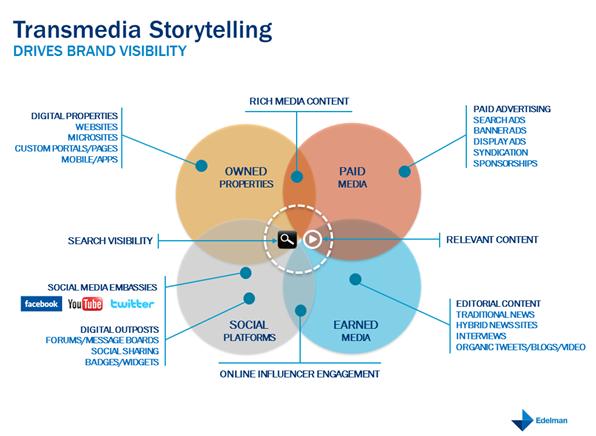
During our first discussion on the topic, Mike referred me to Henry Jenkins, author of the book Convergence Culture. Henry Jenkins has written quite extensively given the relatively new concept and has warned that as an emerging subject, different people have different understandings of what transmedia storytelling actually is. He mentions specifically that the term 'transmedia' actually means "across media" and may be applied to similar, but different concepts. I think this is an important point and I refer back to myself slightly misunderstanding the concept when I first read about it. It is important to remember that 'transmedia storytelling' should not to be confused with 'cross-platform' franchises. The concept as a whole, despite the specifics is incredibly broad and what is interesting to think about is the amount of opportunities there is for storytelling in this manner. The production of transmedia material involves creating content that engages audience and should inherently be innovative and exciting to be the most effective in this regard. To take full advantage of the transmedia technique, each piece of content delivered must provide the audience with a unique experience and a good piece of content within each avenue of delivery. Finally, they should all be interconnected and linked together so that the audience can move between them and get the most from the experience while being able to involve people who may not have access to them all at once.
Subscribe to:
Comments (Atom)